Brain and Mind Technology
Neuroscience
Neuroscience is a multidisciplinary field that seeks to understand the structure and function of the nervous system. It encompasses a wide range of approaches, including molecular and cellular biology, anatomy, physiology, psychology, and computational modeling. By studying the brain and nervous system, neuroscientists aim to shed light on how we perceive the world, make decisions, learn and remember, and experience emotions.
One of the most significant breakthroughs in neuroscience in recent years has been the development of optogenetics, a technique that allows researchers to control the activity of specific neurons in the brain using light. By inserting light-sensitive proteins into neurons, researchers can use a laser to activate or inhibit the neurons, allowing them to study how different parts of the brain contribute to behavior, cognition, and disease. Optogenetics has already led to a deeper understanding of the neural basis of movement, addiction, and depression.
Another exciting area of neuroscience research is the study of the brain's connectome, or the complete network of connections between neurons in the brain. Advances in imaging technology have made it possible to map the connectome with unprecedented detail, providing insights into how different brain regions communicate and how information is processed. Mapping the connectome may also help us understand how changes in the brain's wiring contribute to neurological and psychiatric disorders such as Alzheimer's disease and schizophrenia.
Neuroscience research is also shedding light on the relationship between the brain and behavior. For example, recent studies have shown that the gut microbiome, the collection of microorganisms that live in our digestive tracts, can influence brain function and behavior. Researchers are exploring the potential of manipulating the microbiome to treat neurological and psychiatric disorders such as anxiety and depression.
Looking to the future, there is hope that neuroscience research will lead to new treatments for a wide range of neurological and psychiatric disorders. One promising avenue of research is the development of brain-computer interfaces (BCIs), which allow individuals with paralysis or other motor disorders to control external devices such as prosthetic limbs using their thoughts. BCIs could also be used to treat conditions such as chronic pain or depression by stimulating specific regions of the brain.
Future breakthroughs in neuroscience could have a great effect on society. What will the world be like when technology can tell us without a doubt that the accused is guilty of a crime, a spouse has cheated, or an employee would likely steal? How about uploading your memories for posterity or downloading the skills you need for that new job? Record your dreams for later viewing or control your computer (or any device), just by thinking about it. Many of these futuristic technologies are already in development.
Researchers are studying ways to improve memory, learning and other mental abilities by using substances called cognitive enhancers or smart drugs. Some experts predict that by the year 2050, computers will have the capacity to store all of the information contained in the human brain. For those that can afford immortality, their brains could be scanned and downloaded to machines, perhaps to be uploaded to a new brain.
Overall, neuroscience research has the potential to transform our understanding of the brain and how it influences our behavior and experiences. By advancing our knowledge of the nervous system, we can develop new therapies and interventions to improve the lives of individuals with neurological and psychiatric disorders.
Here as some general facts about the brain:
Center of the human nervous system
Most complex organ on earth
Weighs on average about 3 lb (1.5 kg)
Consistency similar to jelly
Estimated 50–100 billion neurons
Brain Machine Interface
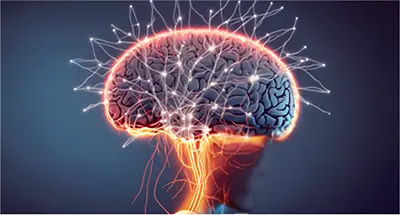
Brain machine interfaces (BMIs), allow for activity in the brain to be sent to, or received from, a computer.
Some BMIs use sensors mounted in a removable cap or MRI technology to read signals from the brain. Others connect directly to the surface of the brain, through tiny wires and an array of micro-electrodes. BMIs can also be entirely implanted in the brain.
Lie Detection

Powerful lie detection tools may someday surpass the accuracy of the polygraph and permanently change how suspects are convicted -- and freed.
Imagine, a suspect is read words related to a crime while their brain is being scanned. A computer analyzes the data and informs the examiner if the suspect's memory holds information about the crime that only the perpetrator could know. The guilty could be clearly identified and the innocent would be set free.
Brain Technology Articles and Web Sites
I search the internet daily for new articles from around the world that interest me or I think will interest you. My hope is that it saves you time or helps students with their assignments. Listed by most recent first, dating back to 2005.
-
To flexibly organize thought, the brain makes use of space from MIT News
-
Five-Year-Old Mini Brains Can Now Mimic a Kindergartener’s Neural Wiring. It’s Time to Talk Ethics. from Singularity Hub
-
These Brain Implants Are Smaller Than Cells and Can Be Injected Into Veins from Singularity Hub
-
Scientists engineer first fully synthetic brain tissue model from UCR
-
Wireless, laser-shooting, brain implant fits on a grain of salt from New Atlas
-
Unprecedented’ Artificial Neurons Are Part Biological, Part Electrical—Work More Like the Real Thing from Singularity Hub
-
The Problem of Smith: When Mind Uploading Multiplies Identity from Mind Matters
-
Dr. Xuyu Qian's breakthrough analysis of 18 million brain cells advances understanding of human brain development from EurekAlert
-
A new light on neural connections from Google Research
-
Each of the Brain’s Neurons Is Like Multiple Computers Running in Parallel from Singularity Hub
-
What goes on inside toddlers' brains? A pioneering project is trying to find out from BBC
-
This isn't a galaxy — it's a map of a mouse's brain from CBC
-
Octopuses and their relatives are a new animal welfare frontier − here’s what scientists know about consciousness in these unique creatures from The Conversation
-
Science is shattering our intuitions about consciousness video
-
MouseGoggles offer immersive look into neural activity from Cornell Chronical
-
Scientists Crack the Blood-Brain Barrier, Paving Way for New Alzheimer’s Treatments from SciTechDaily
-
Stanford’s Sonic Revolution: Healing the Brain With Ultrasound from SciTechDaily
-
Scientists create first map of DNA modification in the developing human brain from UCLA
-
Scientists produce complete map of a fruit fly brain from ABC (Australia)
-
How a Mind-Controlling Parasite Could Deliver Medicine to the Brain from Singularity Hub
-
Rice neuroscientists to build state-of-the-art neural recording system from Rice University
-
New technology to control the brain using magnetic fields developed from EurekAlert
-
This Translucent Skull Implant for Mice Could Help Scientists Unravel the Brain’s Mysteries from Singularity Hub
-
Meanings of Words Have Been Detected in The Flicker of Individual Brain Cells from Science Alert
-
This MIT Device Maps the Human Brain With Unprecedented Resolution and Speed from Singularity Hub
-
How brain research breakthrough could spark next generation of hearing devices from The Lighthouse
-
How does the brain think? from The Conversation
-
What hybrid mouse/rat brains are showing us about the mind from Freethink
-
Salt-Size Sensors Mimic the Brain from IEEE Spectrum
-
A long-lasting neural probe from Harvard College
-
Brainoware: Pioneering AI and Brain Organoid Fusion from Electropages
-
Rice scientists use blood test to track gene expression in the brain from Rice University
-
MindPortal human-AI telepathy website
-
A breakthrough for brain imaging from University of California