Flu Pandemic
COVID-19 Coronavirus information from the CDC
The Basics of Flu
A flu virus is roughly round, but it can also be elongated or irregularly shaped. Inside are the genetic instructions for making new copies of the virus. Flu's most striking feature is a layer of spikes projecting from its surface. There are two different types of spikes: one which allows the virus to "stick" to a cell and initiate infection, the other is a protein which enables newly formed viruses to exit the host cell.
Virus A, B, C
Influenza viruses are classified as type A, B, or C based upon their protein composition. Type A viruses are found in many kinds of animals, including ducks, chickens, pigs, whales, and also in humans. The type B virus widely circulates in humans. Type C has been found in humans, pigs, and dogs and causes mild respiratory infections, but does not spark epidemics. Type A influenza is the most frightening of the three. It is believed responsible for the global outbreaks of 1918, 1957 and 1968.
Where Influenza Comes From
In nature, the flu virus is found in wild aquatic birds such as ducks and shore birds. It has persisted in these birds for millions of years and does not typically harm them. But the frequently mutating flu viruses can readily jump the species barrier from wild birds to domesticated ducks and then to chickens. From there, the next stop in the infectious chain is often pigs.
Pigs can be infected by both bird (avian) influenza and the form of influenza that infects humans. In a setting such as a farm where chickens, humans and pigs live in close proximity, pigs act as an influenza virus mixing bowl. If a pig is infected with avian and human flu simultaneously, the two types of virus may exchange genes. Such a mutated flu virus can sometimes spread from pigs to people.
In 1997, for the first time, scientists found that bird influenza skipped the pig step and infected humans directly. Alarmed health officials feared a worldwide epidemic (a pandemic). But, fortunately, the virus could not pass between people and thus did not spark an epidemic. Scientists speculate that chickens may now also have the receptor used by human-type viruses.
Source: National Institute of Allergy and Infectious Diseases
Tips to avoid catching the flu:
Cover your nose and mouth with a tissue when you cough or sneeze. Throw the tissue in the trash after you use it.
Wash your hands often with soap and water, especially after you cough or sneeze. Alcohol-based hand cleaners are also effective.
Avoid touching your eyes, nose or mouth. Germs spread this way.
Try to avoid close contact with sick people.
Stay home if you are sick until at least 24 hours after you no longer have a fever (100°F or 37.8°C) or signs of a fever (without
the use of a fever-reducing medicine).
Follow public health advice regarding school closures, avoiding crowds and other social distancing measures.
Source: U.S. Department of Health & Human Services
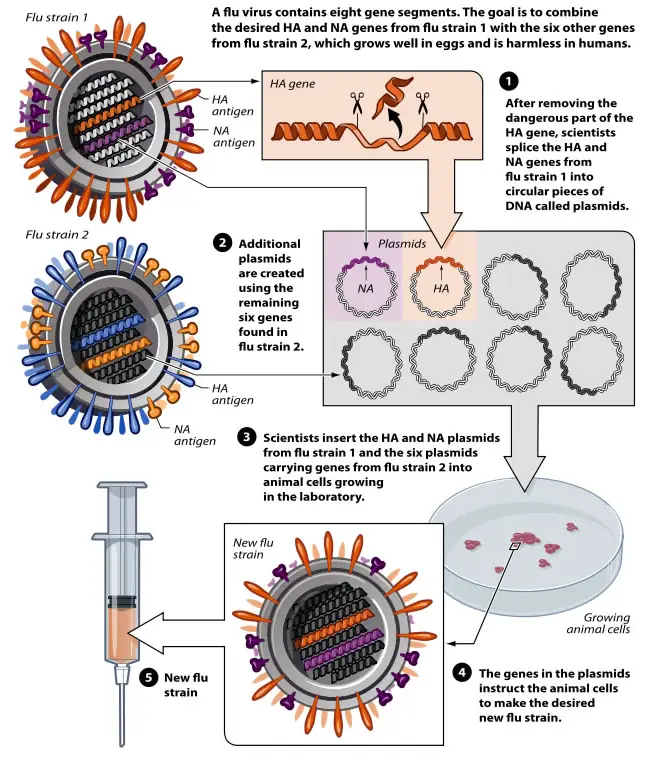
Image of avian flu vaccine development by reverse genetics technique source: Wikimedia
Flu Pandemic Articles and Web Sites
I search the internet daily for new articles from around the world that interest me or I think will interest you. My hope is that it saves you time or helps students with their assignments. Listed by most recent first, dating back to 2005.
-
Could AI help bioterrorists unleash a new pandemic? A new study suggests not yet from Bulletin of the Atomic Scientists
-
New vaccine technology could protect from future viruses and variants from University of Cambridge
-
How AI could spark the next pandemic from Vox
-
A Universal Flu Vaccine Is Getting Closer to Reality from Gizmodo
-
A Universal Flu Vaccine Has Aced Phase I Trials from Freethink
-
The first modern pandemic - gatesnotes.com
-
Scientists close in on cracking 'Enigma Code' of common cold - Medical Express - 02/17
-
Bill Gates Warns That A Devastating Pandemic Is Right Around The Corner - The Huffington Post - 02/17
-
Is a universal flu vaccine within reach? - The John Hopkins Newsletter - 10/16
-
New on-chip optical sensing technique used to detect multiple flu strains - Phys.Org - 10/15
-
New test detects all viruses that infect people, animals - Washington University in St. Louis - 09/15
-
1918 Flu Pandemic -- could it happen again? - Nevada Daily Mail - 01/15
-
Scientists describe deadly immune 'storm' caused by emergent flu infections - Phys.Org - 02/14
-
Online pictures of dead birds spur China flu openness - Phys.Org - 04/13
-
5 ways to protect your child in flu season - CNN - 01/13
-
Young Adults Responded Well to Swine Flu - NSF - 01/12
-
Seagulls carry superbugs that are resistant to antibiotics - Daily Mail - 09/10
-
Avian Influenza Risk in Songbirds Mapped - NSF - 07/10
-
WHO faces questions over swine flu policy - BBC News - 05/10
-
Flu Pandemic Web Sites
-
(WHO) - World Health Organization
-
Flu.gov - U.S. Department of Health & Human Services
-
HealthMap - online informal sources for disease outbreak monitoring and real-time surveillance of emerging public health threats
-
Public Health Corps - Putting the public back into public health