What is the purpose of the Svalbard Global
Seed Vault?
The purpose of the Svalbard Global Seed
Vault is to provide insurance against both incremental and catastrophic loss of crop
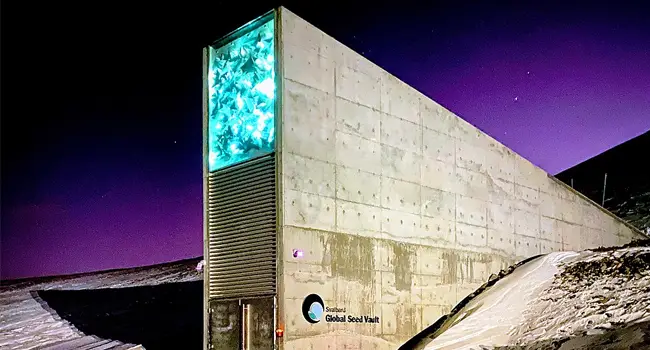
diversity held in genebanks around the world. The Seed Vault offers secure
protection for one of the most important natural resources on earth. It serves as an
essential element in a global network of facilities that conserve crop diversity and make it
available for use in plant breeding and research.
Unfortunately, a significant portion of
the agricultural diversity that has existed on farms has been lost, especially in the
last century. Thankfully, much of that diversity has been collected and stored in genebanks
before it disappeared. Genebanks play a vital role in conserving varieties of
crops that can no longer be found in farmers’ fields.
But genebanks are not 100% safe. Subject
to funding cuts, equipment malfunction, energy failure, natural disasters, civil
strife, war, or simple mismanagement, some genebanks have lost portions of their
collections. The loss of a seed sample can mean the extinction of the variety it
represents, and the loss of the opportunity to benefit from that variety’s unique characteristics. Each loss of a sample therefore decreases the options available to agriculture
worldwide.
The Svalbard Global Seed Vault is the
world’s only global backup seed storage facility for crop diversity. The Seed
Vault provides a safety duplication of seed samples stored in genebanks worldwide,
including international, national, and regional institutes. If the depositors
lose samples in their own genebanks, they will be able to retrieve the duplicates stored at
Svalbard, and replenish their collections.
The Seed Vault does not solve the problem of
continued loss of diversity in farmers’ fields, but does provide a safety net for
the genebanks working to conserve what diversity has been collected. Furthermore,
in the case of a large-scale regional or even global disaster, the remote and
secure location of the Seed Vault gives the seeds representing the world’s agricultural diversity the best chance of survival.
What are the main differences between the
Svalbard Global Seed Vault and other genebanks?
The Seed Vault is a kind of insurance
policy for other genebanks. Plant breeders and researchers depend on genebanks around the
world to obtain varieties with useful traits that they need. If those genebanks
lose their own resources, because of natural or man-made disaster, the collections can
be restored by retrieving the copies from Svalbard.
What are the dimensions of the Svalbard
Global Seed Vault?
The distance from the front door of the
portal building to the back of the Seed Vault is approximately 145.9 meters (478.7 feet).
The width of the each storage room is approximately 9.5 to 10 meters (31.2 to
32.8 feet), the height is 6 meters (19.7 feet), and the length is approximately 27 meters
(88.6 feet).
Who owns the Svalbard Global Seed Vault?
The Seed Vault is owned by the Government
of Norway.
Who runs the Svalbard Global Seed Vault?
An International Advisory Council oversees the management and operations of
the Seed Vault. There are no permanent staff persons
on-site. Staff travel to Svalbard as necessary to monitor the facility and
process new shipments when they arrive. Local officials also monitor the facility using
electronic surveillance.
How much did it cost to build the Svalbard
Global Seed Vault?
The construction cost for the Seed Vault
was approximately 48 million Norwegian Kroner (NOK)\ $9 million (USD). The cost
was funded entirely by the Kingdom of Norway.
Who can store seeds in the Svalbard Global
Seed Vault?
The facility can be used free of charge by
any genebank or seed conservation organization in any country.
Who owns the seeds in the Svalbard Global
Seed Vault?
The Seed Vault functions like a safety
deposit box in a bank. The bank owns the building and the depositor owns the
contents of his or her box.
Why Norway? Why Svalbard?
Svalbard was considered an ideal physical
location for a long-term seed storage facility requiring minimal operational
costs. The arctic permafrost offers natural freezing for the seeds, a key requirement
for long-term conservation. Additional mechanical cooling down to -18° Celsius,
the international standard, is easily accomplished.
• The technical conditions at the site
were virtually perfect. The location inside a mountain obviously increases security and
provides unparalleled insulation properties. The area is geologically stable. Radiation
levels inside the mountain are quite low. Humidity is relatively low. And it was
possible to position the facility far above the point of any projected or possible sea level rise due to climate change (130 meters /430 ft above sea level).
• Svalbard is remote and yet accessible.
Seeds can easily be transported to and retrieved from Svalbard, and the area has
good communications links.
• Infrastructure is excellent. Locally
mined coal provides power generation. Even if the equipment fails, a considerable time
will elapse before the temperature rises to the −3 °C (27 °F) of the surrounding sandstone bedrock.
• The political situation is stable. The
local government is highly competent and helpful. The local community also is small
and supportive.
• There is experience in storing seeds and
managing underground sites in Svalbard. The Nordic countries have been conserving
a backup collection of their seeds in a coalmine in Svalbard since 1984.
• Norway is a trusted country. It also is
unusually “global” in its outlook, and generous when it comes to supporting
positive international initiatives. Norway has no perceived conflict of interest in
hosting the site.
• Military activity is prohibited in the
region under the terms of the Treaty of Svalbard (1920).
• And finally, those involved in the
conceptualizing of the project had close ties with and access to policy-makers in Norway,
facilitating consideration of the proposal at the highest levels of government.
How is the Svalbard Global Seed Vault
protected from access?
The region on Svalbard surrounding the
Seed Vault is remote, severe, and inhabited by polar bears. Anyone seeking access to
the seeds themselves will have to pass through four locked doors: the heavy steel
entrance doors, a second door approximately 115 meters down the tunnel
and finally the two keyed air-locked doors. Keys are coded to allow access to different levels of the facility. Not all keys unlock all doors.
How many seeds are currently stored in the
Svalbard Global Seed Vault?
There are currently over 300,000 samples
stored in the Seed Vault, totaling over 150 million seeds.
How many seeds will be stored in the
Svalbard Global Seed Vault?
The Seed Vault has the capacity to store
4.5 million seed samples, more than the total number of varieties in existence. Each
sample contains an average count of 500 seeds, so a maximum of 2.25 billion seeds could
be stored in the facility. The collection and storage of seeds will continue for some
time. When just half of the first of three storage rooms is filled, it will hold the
world’s largest collection of seeds.
How are the seeds stored?
The seeds are stored at -18° Celsius (-0.4° Fahrenheit). The
seeds are sealed in specially designed four-ply foil packages,
placed in sealed boxes and stored on shelves inside the Seed Vault.
How long can seeds be stored in the
Svalbard Global Seed Vault?
If properly stored and maintained at
appropriate temperatures, some seeds in the Seed Vault will probably be viable for a
millennium or more. As long- term seed conservation in genebanks began only in
the last century, predicting seed longevity relies on statistical extrapolations. Such
research shows that seed longevity varies considerably between species. If properly stored and maintained at appropriate temperatures, some seeds in the Seed Vault
will be viable for a millennium or more.
For example at -20° Celsius, barley can
potentially last 2000 years, wheat 1700 years, and sorghum almost 20,000 years. Even the
most short-lived crop seeds typically survive for at least a half-century.
In any case, seed will be renewed
regularly, and the Seed Vault will always have a good, healthy sample ready just in case
it is needed.
What happens if the electricity goes out?
The arctic permafrost offers natural
freezing for the seeds, a key requirement for long term conservation. Additional mechanical
cooling down to -18° Celsius, the international standard, is accomplished
with only a single 10-kilowatt compressor, which is powered by locally generated electricity. If the equipment or the electricity fails, considerable time will elapse
before the temperature would rise to the −3 °C (27 °F) of the surrounding sandstone bedrock,
which is still satisfactory for keeping seeds frozen. Therefore there will be adequate
time to have the equipment repaired before any damage is done to the seeds.
Even given worst-case scenarios for global
warming, the Seed Vault storage rooms will remain naturally frozen for up to 200
years according to the Norwegian Meteorological Institute, and very cold
and exceptionally well insulated for as far into the future as one can imagine. Under any scenario, therefore, the Vault remains, in absolute and relative terms, the best
possible location for providing secure and reliable conditions for seed storage.
Will genetically modified (GM) plants and
seeds be stored in Svalbard Global Seed Vault?
No GM seeds are stored in the Seed Vault.
A global disaster is unlikely. Isn’t the
Svalbard Global Seed Vault a waste of money?
The major threats and the principal causes
of loss of diversity in genebanks have to do with management, infrastructure, and
funding problems. They are not catastrophic or apocalyptic; they are not the stuff of
newspaper headlines. But they are deadly nonetheless. Given the current state of
many of the world’s genebanks, “doomsday” for seeds could be any day.
The world does not need to experience
apocalypse in order for the Seed Vault to be useful and to repay its costs thousands of
times over. The seed samples stored in the Seed Vault are copies of samples stored in
the depositing genebanks. If the Seed Vault simply re-supplies genebanks with samples that those genebanks lose accidentally, it will pay for itself many times over in terms of the value of those samples to food security and sustainable
agriculture.
How long did it take to build the Svalbard
Global Seed Vault?
The Seed Vault was built within one year.
Most of the construction was completed in about 8 months.
The architect is Peter W. Søderman at
Barlindhaug
Consult.

What is a genebank?
A genebank is a facility for maintaining
crop diversity, typically in the form of seeds, usually stored and conserved in a frozen
state. The ideal temperature is between -10 and -20° Celsius. Each different
type of seed is stored in its own container, such as a bottle, can, or sealed aluminum foil
package. Genebanks may also contain living plants and vegetative parts of plants,
especially for crops that do not store well in the form of seeds.
How many genebanks are there?
According to the UN Food and Agriculture
Organization, there are approximately 1400 genebanks in more than
100 countries around the world.
Approximately 6.5 million seeds samples
are stored in genebanks today. About 1 to 2 million of
these seeds are estimated to be distinct.
What is crop diversity?
Crop diversity is the biological base of
agriculture. Agriculture depends on relatively few crops (only about 150 are cultivated
on any significant scale worldwide); however, each comes in a vast range of
different forms. They may vary, for example, in height, flower color, branching
pattern, fruiting time, seed size, or flavor. They may also vary in less obvious ways such as their response to cold, heat, or drought; nutritional qualities; or their ability to
tolerate specific pests and diseases. Farmers and scientists must continually draw on
this irreplaceable resource to ensure productive harvests.
Is it really necessary to conserve such a
big diversity of crops?
Crop varieties have different
characteristics. Not all the differences are visible to
the eye. Genetic traits may contain a wealth
of differences in disease resistance, adaptability to various soils and
climates, different tastes, and nutritional qualities. If we ever need these unique and often hidden
traits found in particular crop varieties, then we must ensure that the variety is
available. And it is impossible to know which traits may be useful in 10, 25, or 100
years from now.
Why is the Svalbard Global Seed Vault
important to developing countries?
Food security is a challenge in many
developing countries. Crop diversity is the resource to which plant breeders must turn
to develop varieties that can withstand pests, diseases, and remain productive in
the face of changing climates. Diversity therefore underpins the security of the
world’s food supply. Storage of seed samples from developing country genebanks in the
Seed Vault will ensure that unique diversity held in genebanks in developing
countries is not lost forever if an accident or disaster occurs.